Hosmer Grove:
- Hosmer Grove got its name from Ralph S. Hosmer (1874-1963). He was the first Superintendent of Forestry of the Territory of Hawai‘i. He planted many Eucalyptus trees in Hosmer Grove, along with other trees from around the world, as part of his experiments. Many of the trees he planted had shallow roots and didn’t survive, but there are still many Eucalyptus trees like the one Makoa flew to and felt safe in.
- Haleakalā National Park staff, at the time of my books’ publication, offers short weekly hikes and a longer monthly hike at Hosmer Grove for your birding adventures!
- All birds mentioned in our story can be found at Hosmer’s Grove.
- You’ll see few Mynah birds at these higher elevations. This is why the Mynah in our story is called Makoa. We learned Makoa means brave. Makoa is brave like one of the few mynahs to explore farther up Haleakalā!
- We also read that Makoa Mynah felt scared when he saw and heard the angry Nēnē. He felt so scared that he flew to the highest Eucalyptus tree! This part of the story reminds us that our feelings can change. Think about and talk about parts of your day…Did your feelings change too?
- Is there something new you feel brave, comfortable to try?
Here’s a little more information on some native trees our honeycreepers enjoy at Hosmer Grove:
- ʻĀkala (Hawaiian Rasberry or Blueberry): a tart, juicy fruit about 2 inches long, gives a favorite nectar for ʻIʻiwi and ʻApapane. The pink juice from its dark pink blossoms was used for dyes in ancient Hawaii.
- Māmane: up to 50 feet high, Yellow Blossoms, Pea Pods with seeds..Kiwikiu loves these!
- Ōhelo: These bell-shaped flowers ripen into fat, round, pink, purple, deep magenta and periwinkle berries. This is the Hawaiian Blueberry, Nēnēʻs favorite, and we can eat them too!
Learning About Our Feathered Friends
Use the “Feathered Friends” page to discuss individual traits of our birds:
- Differences and Similarities in size, color, beaks
- Both ʻIʻiwi and ʻApapane are red. How can you tell them apart?
- What differences do they have?
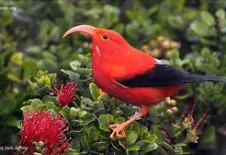
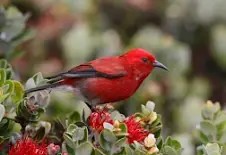
Let’s Take A Closer Look At Kiwikiu
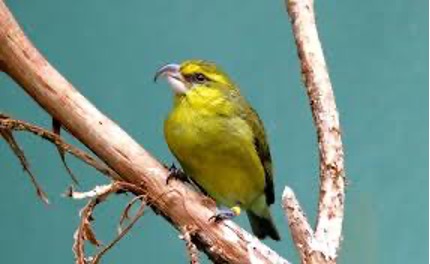
Kiwikiu
- Like ʻApapane and ʻIʻiwi, Kiwikiu is a honeycreeper too! Kiwikiu likes to hang out with our red honeycreepers at the gulch in Hosmer Grove. Kiwikiu likes the ʻŌhiʻa Lehua trees like ʻIʻiwi and and ʻApapane, but he does not feed on nectar like these red feathered friends. Kiwikiu uses his strong can opener type beak for tearing apart the bark of the ʻŌhiʻa trees, Māmāne trees, and ʻĀkala trees, then feeds on the insects and grubs he finds there.
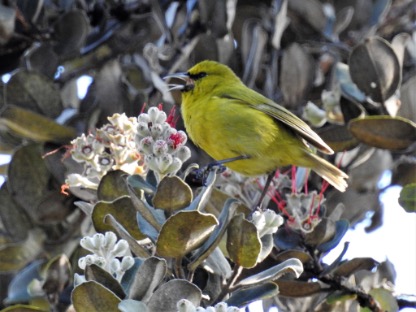
ʻAmakihi
- ʻAmakihi, another native forest honeycreeper, but not mentioned in our story, looks a lot like Kiwikiu! You may need your binoculars to take an even closer look! ʻAmakihi, is yellow green, has a more dominant black “mask” at its eyes, and a fluffier tennis ball like feathered body. A close look at these birds beaks will help you identify them for sure. Just remember, Kiwikiu led the “snack break” for all his feathered friends with his strong, curved, thick, parrot like beak! No, Kiwikiu is not related to parrots! You’ll likely see more ʻAmakihi while bird watching, there are more of them in the forest to see! They are abundant. Poor Kiwikiu is endangered.
Categorize Birds:
- Which birds are threatened? Check out the “About Our Feathered Friends” page!
- Birds are “threatened” if they are at risk of no longer existing.
- Changes to the natural environments where our birds live, other animals, and diseases from mosquitoes put our birds in danger and lessen their numbers.
- Which birds are endemic or native?
- ʻIʻiwi, ʻApapane, Kiwikiu, Pueo, Nēnē
- What about the other birds?
- Mynah came from India.
- Kōlea (Golden Plover), comes from Alaska.
Friends can be alike. Friends can be different. Discuss and celebrate similarities and differences.
Interesting Fact About The Nēnē Goose, our Hawaiʻi State Bird
- About half a million years ago, around the time that Hawaiʻi island was being formed, a flock of Canada geese was blown off course and landed in Hawaii. The descendants of the Canada geese evolved into three species: the nēnē, nēnē nui, and the giant Hawaiian goose.
What makes Pueo different from other owls?
- Pueo’s feathers are darker than the slightly larger Barn Owl. The Pueo is active during the day (diurnal). Pueo hunts for food, mostly small mice and insects, and soars in skies above pastures in the early mornings and afternoons. Other owls are active at night (nocturnal).
- The Pueo is greatly loved and respected in Hawaiian culture. Hawaiian legends teach us that Pueo offers guidance and protection. We can ask Pueo for advice! Sometimes Pueo answers us in our dreams!

Something Worth Noting: “The Aloha Way”!
Reinforce your childʻs use of "The Aloha Way" as you simply say what you see...catch your child in practice of inclusive play with friends and family members.
Point out your child's use of compassion, empathy, mutual respect, love and peace.
Does the story’s themes relate to any other personal experiences or questions your keiki may have?

 Lori Abreu